
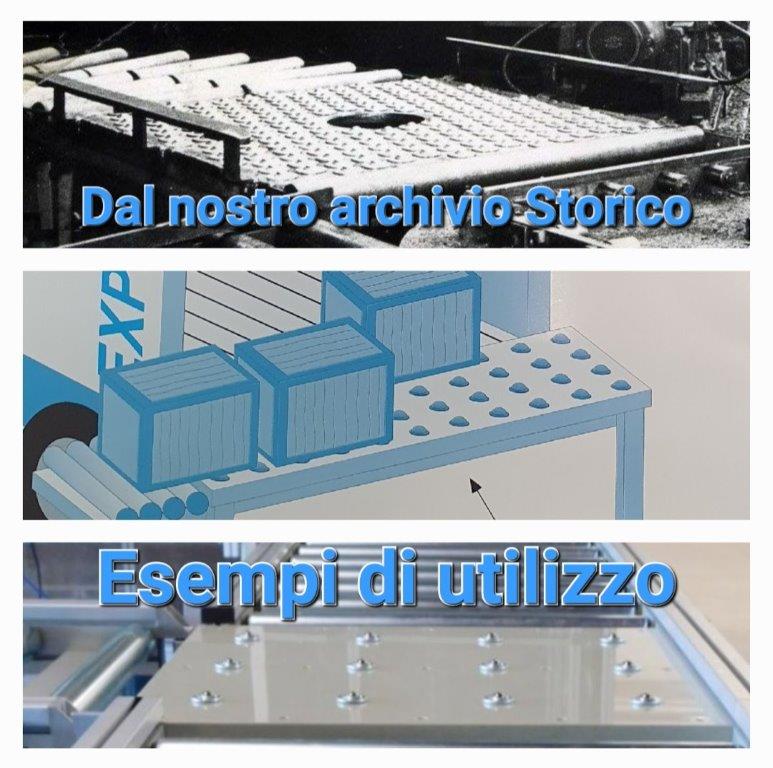
The ball transfer tables are systems conceived to facilitate the manual handling of goods, semi-finished products and components, including heavy items. Thanks to the ball transfer units integrated in the surface, the load can be moved and rotated in any direction with less efforts compared to dragging it on a conventional surface.
These solutions are normally used in production departments, assembly and packaging lines, in warehouses and airport logistics. They can be manufactured in standard sizes, custom-made or modular solutions, to suit the available space, material weight and requirements of the facility operating modes.
How Ball Transfer Tables work
A ball transfer table consists of a solid frame and a metal-sheet panel, where ball transfer units are placed, according to a pre-calculated distance. Each ball transfer unit consists of a main ball, upon which the load rests, supported by a certain number of small balls, allowing the omnidirectional movement.
Unlike rollers and roller conveyors, which guide movement along a main direction, ball transfer units allow for an immediate change in direction. Operators can thus easily move, orient, or rotate the workpiece on place, avoiding the use of other handling systems.
The system can be used as a working table, connecting element between two lines, loading and unloading surface, or on lifting platforms. The configuration depends on the characteristics of the material to be handled and production cycle into which the ball transfer table is to be integrated.
Advantages of using ball transfer tables
The use of ball transfer tables makes many repetitive operations smoother and allows better organization of the material handling. The main advantages are:
- Omnidirectional handling of the load;
- Possibility to rotate and place with precision bulky workpieces;
- Less effort required for the operator;
- Easier connection between workstations, machines and transport lines;
- Possible bespoke configuration as for dimensions, ball pitch and type of BTU;
- Use with different materials and loads, provided the system is correctly designed.
To obtain these advantages it is important to design the ball transfer table considering not only the total weight of the load but also the contact surface. Indeed, the load must be simultaneously supported by an adequate number of ball transfer units.
How to choose ball transfer units for ball transfer tables
The choice of ball transfer units for ball transfer tables, as well as for platforms and decks, directly affects the system’s load capacity, the smooth movement and system’s service life.
The main elements to consider are:
- weight of the product to be handled;
- dimensions of the item to be handled;
- Type of contact surface;
- Environmental conditions.
Diameter and load capacity
The diameter of the main ball has to comply with the required application. Ball transfer units with main ball diameters of 15, 22 or 25 mm are often used for standard working tables, whereas heavy load applications require larger diameters.
A specific example is represented by the SP 45, a BTU with 45 mm main ball, available in flanged or not flanged versions. In the configurations stated by the manufacturer, the load capacity can reach 600 kg with AISI 52100 chrome steel balls and 400 kg in the version with AISI 420 C stainless steel balls. The variant with main ball in plastic material is designed for specific requirements and has a lower load capacity, which is of 30 kg.
Materials and operating environments
Ball transfer units are available in turned steel or pressed metal-sheet versions, depending also on the required dimensions.
Ball tranfer units made in turned steel are suggested when robustness, wear resistance and high load capacity are required.
Ball transfer units in pressed metal-sheet , on the other hand, represent a lighter and more cost-effective solution, provided the application and load allow for it.
To make the best choice, it is important to consider the working environment, particularly the presence of moisture, dust, impurities and atmospheric agents. Consequently, the choice of material for the components, the type of balls and the surface treatments are evaluated, as well as the presence of 1 or more drain holes.
Ball pitch and contact surface area:
The ball pitch defines the spacing between ball transfer units inserted in the ball transfer table. It has to be calculated, so that the load is always supported by a sufficient number of elements. Small items with a flexible base typically require a closer spacing of units, compared to a large and structurally stable item.
Furthermore, the diameter of the hole has to comply with the housing dimensions of the ball transfer unit. Where necessary, BTUs can be secured using fixing rings and compensating rings; depending on the version of the ball transfer unit, other fixing options may be considered.
Industrial applications of ball transfer units
Ball transfer tables can be integrated into different production and logistics fields.
In packaging and wrapping operations, they facilitate the transfer of the packages between different stages of the line. In assembly departments, they allow components to be oriented, while in machine tools they facilitate the feeding and positioning of metal-sheets, panels and moulds.
They are used also in wood and paper industries, sheet metal processing, in the automotive, aerospace, energy, oil and gas, and marine sectors.
Depending on the handling project, ball transfer units can be integrated into platforms, decks, lift tables, and lifting platforms systems intended to move heavy loads.
Decks and platforms for airport cargo handling
In the airport sector, ball transfer units are installed in specially designed decks or platforms, used for the omnidirectional movement of ULDs (Unit Load Devices) o air cargo pallet. Ball transfer units are also used in lifting systems of “cargo high loaders”-airport transfer vehicles classified as GSE, Ground Support Equipment.
The most widely used ball transfer units in the airport sector are represented by SP 30 and SP 45 , used in standard as well as Cargo and CX Airport “calotta inox” versions. These configurations are designed to combine load capacity, smoothness in movement and resistance to operating conditions. The SP 30 Cargo version, in particular, has a stainless steel plate on the bottom, with 7 holes, for draining impurities, while the SP 30 CX Airport “calotta inox” has a stainless steel inner cup available with either 1 or 5 holes.
However, it is necessary to define the appropriate characteristics according to the environment, the system and the load to be handled.
The same solutions can also be used in logistics platforms, harbors and other industrial systems requiring the omnidirectional movement of heavy loads.
Design and maintenance of ball transfer tables
The efficiency of a ball transfer table does not depend exclusively on the nominal load capacity of the individual units. A correct dimensioning must take into account load distribution, the number of balls in simultaneous contact with the load, the ball pitch, the material, the fastening system and real operating conditions.
To ensure proper operation, it is important to schedule regular maintenance cycles and check the wear conditions. A proper maintenance aligned with the intensity of use, helps preserve smoothness, safety and operational continuity.
Bespoke ball transfer tables
Effeciesse manufactures ball transfer units and supports the application in ball transfer tables for different industrial needs. The choice may involve diameter, material, load capacity, fastening, unit spacing, and special configurations.
To find the most proper ball transfer units for your ball transfer tables, visit the section “products” of our website and contact us for any further explanation